The Back View Is the Truth: A Studio Practice for Fitting Clothes in Three Angles
There is a particular kind of optimism in a fitting-room mirror. It gives us the front view, the angle we have been trained to present, and it asks very little else of us. In the studio, we have learned to distrust that singular view. A dress can be persuasive head-on and still pull at the shoulder, drift at the hem, or gather at the seat in a way that will announce itself by the end of a long day. The question is not whether a garment photographs well from the front. The question is what it does when no one is arranging it.
A Practice, Not a Rule
We call the exercise a three-angle check, though it is less a rule than a habit of looking. The aim is simple: see the garment from the front, the back, and the side before deciding whether it belongs in your life. Most wardrobes are built on the first view alone. The pieces that last are the ones that survive the other two.
Set up is modest. You need a full-length mirror and a second reflective surface, ideally another full-length mirror placed at an angle so that the back view becomes visible without contortion. A narrow closet mirror, a dressing mirror on a stand, or even a large tablet propped in video mode can serve. The point is not precision equipment. The point is removing the need to twist, crane, or guess.
Stand in neutral light, ideally daylight from a window rather than the warm glow of a bedroom lamp. Wear the underlayers you would actually wear with the garment. Put on the shoes you intend to wear, or a pair with a comparable heel. Then step back far enough to see the whole silhouette. Six to eight feet is usually enough.
The Front: What You Are Asking For
The front view is familiar, so use it carefully. Look for the line of the shoulder and the way the neckline sits. Check whether the closure lies flat without strain. Notice if the fabric pulls across the chest or falls away in a way that feels unresolved. A good front view should not require constant adjustment. If you find yourself tugging at the hem or smoothing the bodice within the first minute, make a note.
The front is also where we tend to mistake novelty for fit. A dramatic sleeve or an unusual seam can distract from a shoulder that is too wide or an armhole that cuts. Let the details settle. Look at the whole garment, then look again at the places where it meets the body: shoulder, bust, waist, hip. Those junctions tell you more than any single design gesture.
The Back: Where the Garment Tells the Truth
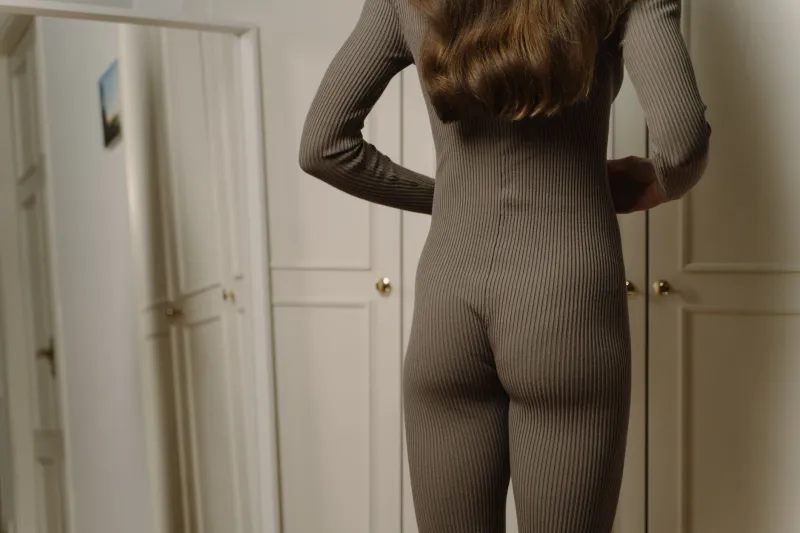
The back view is often neglected because it is difficult to see and easy to imagine. It is also where many garments reveal their construction. Check the back yoke, if there is one, and the way the fabric sits across the shoulder blades. Look at the center back seam or closure. Does it lie straight? Does it pull? Is there a gap at the neckline that will widen when you move?
At the seat, pay attention to tension and drape. A garment should skim without clinging, release without collapsing. If the fabric gathers across the seat or pulls into horizontal folds, the fit may be too narrow through the hip. If it hangs away in a stiff tent, the shape may be too generous for the way you intend to wear it. Neither is automatically wrong, but both are information.
The back of the hem deserves its own moment. A hem that rises at the center back or dips at one side will bother you every time you catch your reflection in a shop window. It is not vanity. It is the quiet arithmetic of a garment that does not sit level.
The Side: Motion and Proportion
The side view is where proportion becomes legible. Check the shoulder-to-hem line, the placement of the waist, and the relationship between the front and back of the body. A side seam that swings forward or backward can signal a balance issue in the cut. A pocket that gapes at the side is not a small flaw; it is a daily annoyance waiting to happen.
This is also the view in which you should move. Raise an arm. Sit down. Take a few steps. The side profile shows how a garment behaves in motion, and motion is the true test of a wardrobe piece. A coat that looks sculptural standing still may reveal a strained armhole when you reach for a bus strap. A skirt that falls beautifully at rest may twist when you walk. You are not looking for perfection. You are looking for composure.
The Shoulder, the Hem, and the Seat
If you remember only three places to inspect, make them these. The shoulder is the architecture of the garment. It should sit where your shoulder actually is, not where a pattern intended it to be. The hem is the garment's honesty. It should be level, clean, and appropriate to the weight of the fabric. The seat is the garment's temperament. It should allow you to sit, walk, and forget you are wearing it.
These three points are unglamorous, which is why they matter. They are the places where a garment either supports a life or interferes with it. A beautiful front can carry a garment through a mirror check. A well-resolved shoulder, hem, and seat carry it through a Tuesday.
What Passes
The pieces that pass this three-angle check are rarely the most dramatic things in the closet. They are the ones you reach for without thinking: the jacket whose shoulder never needs a tug, the trousers whose seat stays smooth after a long lunch, the dress whose hem finds the same quiet line whether you are standing at a counter or walking to the train. They do not ask for maintenance. They return your attention to the day.
That is the purpose of the practice. It is not to find fault with every garment, but to notice which ones are already doing their work. In the studio, we would rather make fewer pieces that survive all three views than many that only survive the first. The same standard serves a wardrobe. Stand back. Turn. Look again. The garment will tell you what it intends to do.