An Inside Job: Reading the Unseen Architecture of a Garment
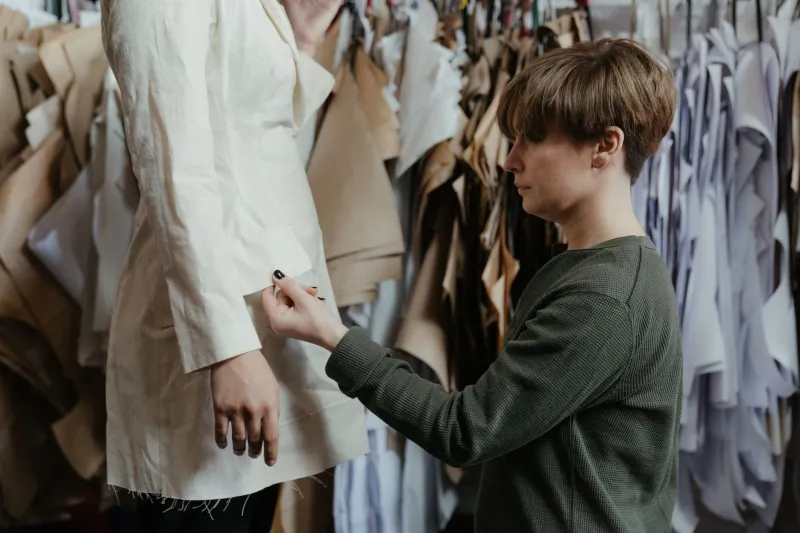
A garment presents two lives. The first is public: the line of a shoulder, the weight of a hem, the color under daylight. The second is private, and it begins at the inside seam. In the studio, we turn clothes inside out almost before we look at them. Not out of suspicion, but out of habit. The exterior may persuade, yet the interior explains. A lining is the quiet architecture of a garment, and it tells a shopper what the maker believed about comfort, longevity, and the person who would wear the piece.
The Seam Finish Is the First Honest Sentence
Open a jacket or a dress and look at the lining seams. They need not be decorative, but they should be resolved. A cleanly finished seam has no raw edge waiting to fray, no loose thread traveling toward a buttonhole, no pucker that will press through the outer cloth after a season of wear. French seams, bound seams, and well-tensioned overlock stitches all have their place. What matters is whether the finish suits the fabric and the garment's intended life.
A lining cut with adequate seam allowance is easier to alter and less likely to split under movement. If the seam allowance is narrow and untidy, ask why. The exterior may be beautiful, but an unfinished interior is like a well-appointed room with exposed wiring. It may function for a time, yet it signals that the construction was considered only from the front.
Read the Fiber Before You Trust the Hand
Lining fiber content shapes how a garment feels against the body and how it behaves in a New York winter or a humid summer afternoon. Acetate and cupro offer a smooth, cool hand and are common in tailored coats and jackets. Viscose and rayon can drape well, though quality varies widely. Silk remains a refined choice in lightweight dresses and eveningwear. Polyester is not automatically inferior, but it should have a reason to be there: durability, elasticity, or a specific performance benefit. In a close-fitting garment, a nonbreathable lining can turn a polished outfit into a discomfort by midday.
Place the lining against the inside of your wrist for a moment. Does it feel dry and smooth, or does it cling? Does it rustle loudly when you move? A lining should support the outer fabric, not compete with it. Fiber labels are required in the United States, and they are worth reading with the same attention you give the exterior. The lining is the part of the garment that touches the skin most directly; its fiber is not a minor detail.
Test the Attachment Points
A lining should move with the garment, not against it. Check how it is anchored at the shoulders, armholes, waist, and hem. In a tailored jacket, look for a generous back pleat or an action fold that allows the arms to move without pulling the lining tight. In a skirt, the lining should hang freely enough to prevent friction, with a hem that sits slightly shorter than the outer fabric. A lining stitched flat at every seam may look controlled on the hanger, but it can restrict movement and wear through at stress points.
Pick the garment up by its hanger and watch the hem. Does the lining swing naturally? Does it drop back into place? Small tacks and hang loops are quiet courtesies, but they should not be the only thing holding the interior together. A well-attached lining anticipates motion. It understands that a coat is not a display object but a layer worn through streets, trains, and doorways.
Notice the Hand, the Climate, and the Ease
A lining creates the immediate climate of a garment. In a winter coat, a smooth lining lets a sleeve glide over a knit without dragging. In a summer dress, a lightweight cotton or silk lining can add coverage without adding heat. The right lining is seasonally intelligent. It does not simply hide the inside of the cloth; it mediates between the body and the world.
Ease matters here as well. A lining cut too tightly will pull at the shoulders and shorten the life of the garment. A lining cut too loosely can bunch at the waist or twist after cleaning. The best linings are engineered with the same care as the outer shell, with enough room for movement and enough structure to keep their shape. This is not an area for guesswork, and it is one reason a fitting room mirror is only part of the story.
Examine the Quiet Details
The final inspection is a study in restraint. Look at the lining color. It need not match the exterior, but it should feel intentional, whether tonal, contrasting, or printed. Consider the hem allowance. A generous lining hem allows for alterations and accommodates small changes in fit. Check the facings and interior pockets, if present. Do they lie flat? Are they finished? A printed lining can be a pleasure, but it should never be used to distract from careless construction.
A beautiful interior is the quietest mark of a well-made wardrobe. It is not the detail most shoppers photograph, yet it is the one they feel every time they put the garment on. In the studio, we have learned to trust that feeling. The exterior invites you in; the lining tells you whether you should stay. When you look inside a garment, you are not being nosy. You are reading the maker's intentions, one seam at a time.