The Unmade Shelf: What a Studio's Rejection Wall Teaches About Editing a Collection
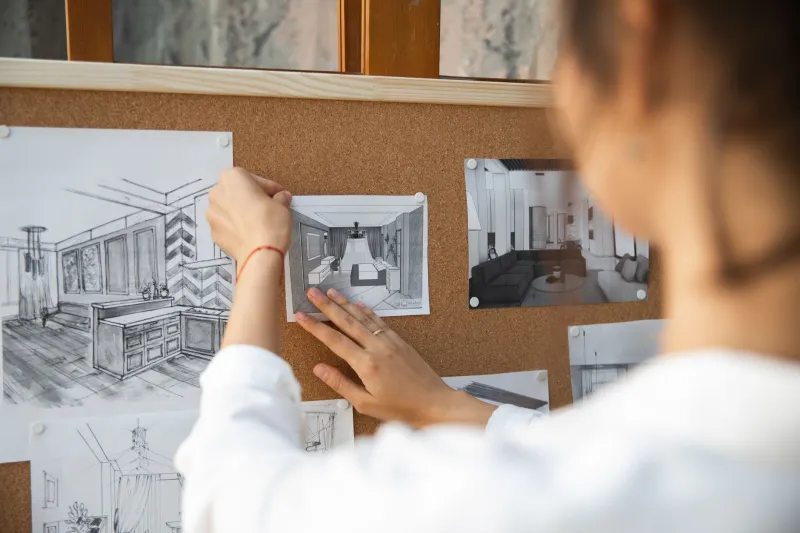
On a gray November afternoon in the Jodi Arnold NYC studio, the most useful wall is not the one with the mood boards. It is the narrow strip beside the pattern table, where sketches are pinned in quiet rows. Some are finished in ink; others are pencil fragments with swatches tucked behind them. None became clothes. All of them shaped the collection.
We call it the rejection wall, though that word is too dramatic for what it is. It is an editing tool. Each pin marks a moment when a design was considered, tested on paper, and set aside. The reasons are written in pencil at the corner of the page: fabric, repetition, motion, cost, body. Those five words explain more about how a collection is made than any lookbook.
A Wall, Not a Graveyard
Nothing on this wall is a failure in the ordinary sense. A sketch can be beautiful and still be wrong for a season. It can be right for a fabric that has not arrived yet, or right for a body that the collection is not addressing. The wall keeps these drawings in view so that the studio does not confuse affection with judgment. We do not keep them to mourn. We keep them to remember what was decided and why.
Visitors often assume the wall is a private museum of near misses. It is more practical than that. When a new sample comes back from the workroom, it is measured against the wall. Does it solve the problem that the rejected sketch could not? Does it repeat a mistake we have already named? The wall is a reference, not a relic.
The First Cut: The Cloth Says No
Most rejections begin with fabric. A drawing can promise a collar that stands away from the neck, a sleeve that holds a clean line, a skirt that moves like water. Cloth has its own opinion. A lightweight wool will not hold a sculptural shoulder without interfacing that makes the garment stiff and unhappy. A silk will not support a sharp pocket without a structure that shows through. If the cloth cannot do the work, the sketch stays on the wall.
This is not a failure of imagination. It is a failure of translation, and translation is the real work of design. A sketch is a proposal. A garment is a negotiation between that proposal and the material. The wall records the negotiations we chose not to pursue.
The Second Cut: The Collection Already Has Its Coat
A collection is not a rack of good ideas. It is an argument, and an argument needs a sequence. If two pieces say nearly the same thing, one of them is redundant. A sketch may be handsome on its own and still be unnecessary beside a coat that already carries the season. We mark those drawings with the word repetition and move on.
There is a discipline in this that shoppers know intuitively. A wardrobe becomes clearer when it stops adding the fifth version of a favorite shape. The studio wall applies the same rule before a single sample is cut. Not every good idea belongs in this collection. Some belong in the next one. Some belong nowhere.
The Third Cut: The Body in Motion
Sketches are static. Bodies are not. A sleeve that looks elegant on paper may bind at the armhole. A skirt may ride when its wearer climbs stairs. A jacket may sit perfectly in a standing fitting and collapse when its wearer reaches for a subway rail. We mark these drawings with the word motion, and the word is a warning.
This is where the wall becomes most useful. It forces the studio to imagine the garment in use, not only in presentation. The city supplies the test: stairs, wind, seats, crowds, the reach for a wallet. A design that cannot survive those ordinary movements has not yet earned its place. The wall holds it until it can.
What the Rejects Teach
The rejection wall teaches restraint, sequence, and timing. Restraint because a collection is defined as much by what is left out as by what is shown. Sequence because one strong piece can make another feel louder or softer, and order matters. Timing because a good idea can be early, late, or simply in the wrong cloth.
Some sketches are moved to a future folder. A rejected collar may return in a heavier fabric. A skirt that failed in silk may succeed in wool. The wall does not condemn an idea; it asks it to wait. When an idea returns, it must earn its place again, against the collection as it now stands.
The wall is also a promise to the wearer. It says that the clothes that do go forward have been chosen against alternatives. They are not the only ideas in the room. They are the ones that survived the studio's questions about cloth, repetition, motion, cost, and body. In a season of too much, that is a quiet kind of luxury: the confidence of the edit.